On this page
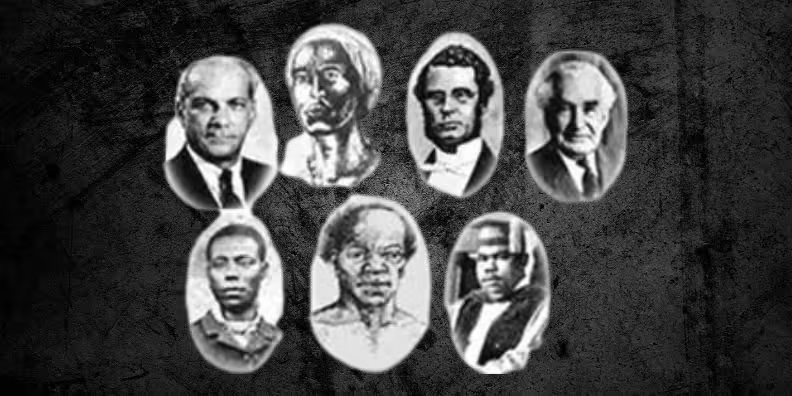
Every Jamaican child learns the seven names in school: Nanny, Sam Sharpe, Paul Bogle, George William Gordon, Marcus Garvey, Norman Manley and Alexander Bustamante. They are Jamaica’s National Heroes, the only people to hold the Order of National Hero, which the Jamaica Information Service, or JIS, describes as the country’s most senior honor. Each one carries the title “The Right Excellent”. Between them, their stories cover almost the whole road from slavery to independence, and that’s why we still talk about them. This guide explains who each hero was, why they were chosen, and what happens on National Heroes Day.
The seven National Heroes at a glance
| Hero | Lived | Known for | Named a National Hero |
|---|---|---|---|
| Nanny of the Maroons | c. 1600s to c. 1740s | Leading the Windward Maroons in the First Maroon War | 1982 |
| Samuel Sharpe | c. 1801 to 1832 | Planning the 1831 Christmas Rebellion against slavery | 1982 |
| George William Gordon | c. 1820s to 1865 | Speaking for the poor in the House of Assembly | 1969 |
| Paul Bogle | c. 1822 to 1865 | Leading the 1865 Morant Bay protest | 1969 |
| Marcus Mosiah Garvey | 1887 to 1940 | Founding the Universal Negro Improvement Association | 1969 |
| Norman Washington Manley | 1893 to 1969 | Founding the PNP and leading the independence talks | 1969 |
| Sir Alexander Bustamante | 1884 to 1977 | Founding the JLP and becoming the first Prime Minister | 1969 |
Dates and years of the award are from JIS. Some early dates are approximate because the records of enslaved and free Black Jamaicans from that time are incomplete.
Nanny of the Maroons
Nanny, or “Granny Nanny”, was a leader of the Windward Maroons at the start of the 18th century. The Maroons were Africans who had escaped slavery and built free communities in the mountains. JIS says Nanny was known to both the Maroons and the British as an outstanding military leader, especially during the First Maroon War of 1720 to 1739, when she organized the guerrilla tactics that kept British troops from pushing into the mountains.
She was also the keeper of her people’s customs, music and stories from Africa. According to JIS, she was angry when the Windward Maroons signed a peace treaty with the British in 1739, because she saw it as another form of control. Legend and fact are woven together in her story, and JIS notes that some Maroons say there were several women leaders at the time. All the accounts agree that Nanny stood out. She is the only woman among the seven, and she and Sam Sharpe were named National Heroes on March 31, 1982.
Samuel Sharpe
Sam Sharpe was born enslaved in St James and became a “daddy”, or leader, of the Native Baptists in Montego Bay. Religious meetings were the only gatherings the enslaved were allowed, and Sharpe used them to share news from England about the fight against slavery. His plan was peaceful: the enslaved would refuse to work after Christmas 1831 until their grievances were heard.
On December 27, 1831, the Kensington Estate great house in St James was set on fire, and the strike became an armed uprising across the western parishes. JIS records that 14 white people died during the rebellion, while more than 500 enslaved people lost their lives, most of them after the trials that followed. Sharpe was hanged on May 23, 1832. He is remembered for saying he would rather die on the gallows than live in slavery. Two years later, in 1834, slavery was abolished and replaced by apprenticeship, and full freedom came in 1838.
Paul Bogle
Paul Bogle was most likely born free, around 1822, and was a Baptist deacon at Stony Gut, a few miles north of Morant Bay in St Thomas. He was one of only 104 people in the parish allowed to vote, and a firm supporter of George William Gordon. Poverty, unfair courts and a government that ignored small farmers pushed him to lead a protest march to the Morant Bay courthouse on October 11, 1865.
The confrontation that followed turned violent, and Governor Edward John Eyre’s response under martial law was brutal. JIS’s history of Jamaica says more than 430 people were executed or shot, hundreds more were flogged and about 1,000 homes were destroyed. The count usually given from the time is 439 people put to death, 354 of them after trial by court martial. Bogle was captured and hanged on October 24, 1865. JIS credits his stand with bringing fairer practices in the courts and a change in official attitudes.
Free Jamaica trip checklist
Want the printable version?
Get my free Jamaica trip checklist, then guides for the part of the island you're visiting.
Your checklist is ready
Download it below, then print it or tick the boxes on screen.
George William Gordon
George William Gordon was born near Mavis Bank in St Andrew to an enslaved mother and a planter father. He taught himself, became a landowner in St Thomas, and entered politics to speak for freed people who could not vote. He sold plots of his own land cheaply to small farmers and set up a way for them to sell their produce at fair prices.
After Morant Bay, Gordon was arrested and charged with being part of the rebellion. JIS says he was illegally tried by court martial and, despite the lack of evidence, sentenced to death. He was executed on October 23, 1865. Jamaica’s Parliament building in Kingston, Gordon House, is named after him.
Marcus Mosiah Garvey
JIS calls Marcus Garvey Jamaica’s first National Hero. He was born in St Ann’s Bay on August 17, 1887, worked as a printer in Kingston, and traveled widely, seeing how Black workers lived across the Americas. In 1914 he founded the Universal Negro Improvement Association (UNIA) in Jamaica, and it grew into an international movement for Black self-government, self-help businesses and protest against racial discrimination.
Garvey moved to the United States in 1916, where officials disapproved of his work; he was imprisoned and then deported. Back in Jamaica he formed the People’s Political Party in 1929 and won a seat on the Kingston and St Andrew council. He later moved to England, where he died in 1940. His body was brought home in 1964 and buried in National Heroes Park. His message of race pride, African unity and self-reliance reached far beyond Jamaica, and it became one of the roots of Rastafari.
Norman Washington Manley
Norman Manley was born at Roxborough, Manchester, on July 4, 1893. JIS describes him as a brilliant scholar, athlete, First World War soldier and lawyer. He stood with workers during the labor unrest of 1938 and founded the People’s National Party (PNP) that September, leading it until he retired in 1969.
Manley backed the Federation of the West Indies, but when Bustamante’s JLP said it would take Jamaica out, Manley called a referendum, and Jamaicans voted to leave. He then chaired the committee that drafted Jamaica’s own constitution and led the team that negotiated independence from Britain. He lost the 1962 election to the JLP and served as Leader of the Opposition. He died on September 2, 1969, and was named a National Hero that October.
Sir Alexander Bustamante
Alexander Bustamante was born in Hanover on February 24, 1884. He first became known in the 1930s through letters to The Gleaner about the poverty of working people, and during the unrest of 1937 and 1938 he became, in the words of JIS, “the undisputed champion of the working class”. He was detained by the colonial authorities in 1940 and released 17 months later.
He founded the Jamaica Labour Party (JLP) in 1943, and in the first election under universal adult suffrage in 1944, the JLP won 22 of the 32 seats. He became the first Prime Minister of independent Jamaica in 1962 and retired from politics in 1967. He died on August 6, 1977, aged 93. Bustamante and Norman Manley were cousins, and they were named National Heroes on the same day, October 18, 1969.
National Heroes Day: what happens on October 19
National Heroes Day is a public holiday on the third Monday in October. This year it falls on Monday, October 19, the date JIS gave when it announced the 2026 National Honours list. It caps Heritage Week, a run of lectures, church services and community events in the days before, and comes just after Paul Bogle Day on October 11, the anniversary of the Morant Bay march.
The day starts with the official salute to the heroes at National Heroes Park in Kingston, with wreaths laid at the shrines. Later the Governor-General presents the National Honours and Awards at King’s House, his official residence in St Andrew. JIS says 140 Jamaicans will be honored this year. It’s a state ceremony for the recipients and their guests rather than a public event, and most of us follow it on TV. Parishes hold their own flag-raising and civic ceremonies too.
If you’re visiting that day, banks and government offices are closed, as on any public holiday. Shops, restaurants and attractions set their own hours, so check with anywhere you plan to go before you set out. Resorts and hotels run as normal, and if you’re staying on the north coast you may not notice much beyond the flags. For many Jamaicans it’s a quiet family day.
Visiting National Heroes Park
National Heroes Park is in downtown Kingston, a short drive from New Kingston and Emancipation Park, so the two fit into a morning. For 101 years the ground was the Kingston Race Course, and it was renamed National Heroes Park in 1973, according to the Jamaica National Heritage Trust. The heroes’ monuments stand in an area called the Shrine, and Garvey, Manley and Bustamante are buried there. A section to the north is set aside for prime ministers and other outstanding Jamaicans. The park is still where the nation pays tribute: in August 2026 Ghana’s President laid a wreath at Garvey’s shrine, JIS reported. On Heroes Day morning the official ceremony comes first, so another day is calmer for a visit. Our Kingston guide covers the rest of the city.
Where to see their stories in Jamaica
Beyond National Heroes Park, the heroes’ stories are tied to places all over the island.
- Morant Bay and Stony Gut, St Thomas. The Jamaica Tourist Board points to Edna Manley’s statue of Paul Bogle in Morant Bay and the memorial at Stony Gut.
- Montego Bay. The main square downtown is Sam Sharpe Square, named for him. Our Montego Bay guide helps you plan a day in town.
- St Ann’s Bay. Garvey’s birthplace, with a statue of him outside the parish library, according to the Jamaica Tourist Board.
- Moore Town, Portland. The Windward Maroon community most closely linked to Nanny.
For more on the events these seven lived through, read our short history of Jamaica, and our guide to historical sites in Jamaica. For lighter reading, from the national bird to James Bond, try these interesting facts about Jamaica.
Questions people ask
How many National Heroes does Jamaica have?
Seven: Nanny of the Maroons, Samuel Sharpe, Paul Bogle, George William Gordon, Marcus Garvey, Norman Manley and Sir Alexander Bustamante. They are the only people to hold the Order of National Hero, Jamaica’s most senior honor.
When is National Heroes Day 2026?
Monday, October 19, 2026. National Heroes Day is always the third Monday in October, and it’s a public holiday in Jamaica.
What happens on National Heroes Day in Jamaica?
The day opens with a salute and wreath-laying at National Heroes Park in Kingston. The Governor-General then presents the National Honours and Awards at King’s House, and parishes hold their own flag-raising and civic ceremonies.
What's open on National Heroes Day in Jamaica?
Banks and government offices are closed. Shops, restaurants and attractions set their own hours, so check ahead, while resorts and hotels run as normal.
Who is the only female National Hero?
Nanny of the Maroons, who led the Windward Maroons against the British in the early 1700s. She was named a National Hero in 1982, along with Sam Sharpe.
Who was Jamaica's first National Hero?
The Jamaica Information Service calls Marcus Garvey Jamaica’s first National Hero. He was born in St Ann’s Bay in 1887 and founded the Universal Negro Improvement Association.
Where are Jamaica's National Heroes buried?
Marcus Garvey, Norman Manley and Alexander Bustamante are buried at National Heroes Park in Kingston, which also has shrines and monuments to the other heroes.
Sources & updates
- Jamaica Information Service: Order of National Hero (members and dates) · checked
- JIS: Nanny of the Maroons · checked
- JIS: Samuel Sharpe · checked
- JIS: Paul Bogle · checked
- JIS: George William Gordon · checked
- JIS: Marcus Mosiah Garvey · checked
- JIS: Norman Washington Manley · checked
- JIS: Sir Alexander Bustamante · checked
- JIS: Independence (National Heroes honored on the third Monday in October) · checked
- Jamaica Tourist Board: National Heroes Day and heritage sites by parish (Oct 2025) · checked
- JIS: Ghana's President lays tribute at Garvey's shrine, National Heroes Park (Aug 2026) · checked
- Jamaica Observer: National Honours and Awards ceremony at King's House on National Heroes Day (Oct 2022) · checked
- Jamaica Information Service: History of Jamaica · checked
- Office of the Prime Minister: Statement to Parliament on the aftermath of Hurricane Melissa (Nov 2025) · checked
- JIS: 140 Jamaicans to receive National Honours and Awards; ceremony on National Heroes Day, Monday, October 19 (Aug 2026) · checked
- The Gleaner: 140 for national honours, ceremony at King's House in October (Aug 2026) · checked
- JIS: National Honours and Awards presented on the lawns of King's House on National Heroes Day (Oct 2025) · checked
- JIS: Heritage Week, Paul Bogle Day and the salute to the heroes at National Heroes Park (Oct 2024) · checked
- JIS: Parish flag-raising and civic ceremonies on National Heroes Day (Oct 2023) · checked
- Jamaica National Heritage Trust: National Heroes Park (history, the Shrine) · checked
- JIS: National Heroes Park in downtown Kingston (May 2022) · checked
- The Gleaner, Peter Espeut: Morant Bay figures, 439 put to death including 354 after courts martial (Oct 2025) · checked
Update log
- — Rewritten as a researched guide; facts re-checked.
- — Moved source citations out of the text
- — Added internal links to related guides
- — Trimmed hurricane references to where they change the advice
- — Added National Heroes Day section
- — Aligned the Morant Bay figures with JIS's history of Jamaica
Spotted something out of date? Tell me and I’ll check it.