
On this page
Most “Jamaica facts” lists online repeat things nobody has checked. This one is different: every fact below comes from an official or primary source, listed at the bottom of the page, and anything I couldn’t confirm has been left out. Some of these, Jamaicans learn in school. A few might surprise even us.
The island
- Jamaica is the third-largest island in the Greater Antilles and the largest English-speaking territory in the Caribbean, according to the Jamaica Information Service, or JIS. It’s about 235 km (146 miles) from east to west and about 80 km (50 miles) at its widest, with an area of roughly 10,991 sq km (4,244 sq miles). That’s why a drive from Negril to Port Antonio takes most of a day.
- It has 14 parishes in three counties, Cornwall, Middlesex and Surrey, and its territory includes some 66 islands, rocks and cays. That count may change: in February 2025 Parliament passed a bill to make Portmore, in St Catherine, Jamaica’s 15th parish, the first new parish since independence.
- About 2.77 million people live here. The 2022 census counted 2,774,538 people, the Statistical Institute of Jamaica announced in October 2025, up 2.8% since 2011.
- The Blue and John Crow Mountains are Jamaica’s first World Heritage Site. UNESCO inscribed them on July 3, 2015, as a mixed site, recognized for both nature and culture, including the Maroon heritage of the mountains. It was the first mixed site in the Caribbean sub-region.
The national symbols
- The motto is “Out of Many, One People”, based on the population’s multiracial roots. It’s on the coat of arms, which shows a Taíno man and woman on either side of a shield with a red cross and five golden pineapples, under a Jamaican crocodile.
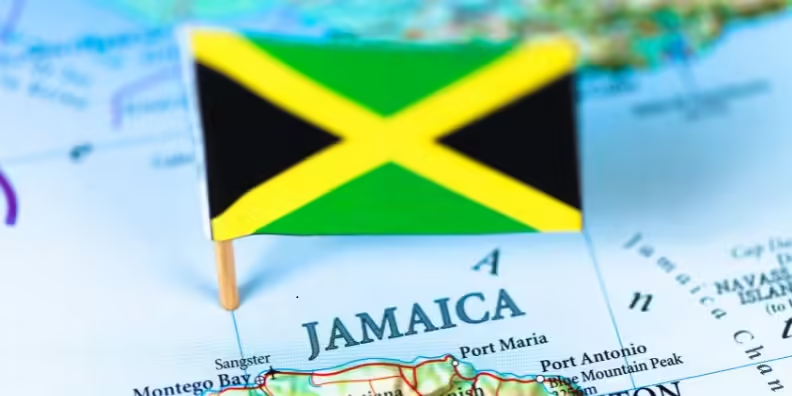
- The flag was designed by a committee of Parliament after a public design competition in 1961 failed to produce a winner. It was raised for the first time at midnight on August 5, 1962, as the British flag came down, and Jamaica became independent on August 6. JIS gives the meaning as “The sun shineth, the land is green and the people are strong and creative”: gold for sunlight and the country’s wealth, green for hope and agriculture, black for the strength and creativity of the people.
- The national bird lives only in Jamaica. The doctor bird, or swallow-tail hummingbird, is found nowhere else. The mature male has two long tail feathers that stream behind him as he flies.
- The national fruit isn’t from Jamaica. Ackee came from West Africa, probably on a slave ship, and its name comes from the Twi language of Ghana. Its botanical name, Blighia sapida, honors Captain William Bligh of the Bounty, who took ackee plants from Jamaica to England in 1793. JIS also credits him with bringing the first breadfruit to Jamaica.
- Ackee can be poisonous. It contains a toxin that’s only safe when the fruit is picked after the pods open naturally and is properly cleaned and cooked. JIS says Jamaica is the only place where ackee is widely eaten. Ackee and saltfish, as any Jamaican will tell you, is the national dish.
Free Jamaica trip checklist
Want the printable version?
Get my free Jamaica trip checklist, then guides for the part of the island you're visiting.
Your checklist is ready
Download it below, then print it or tick the boxes on screen.
Nature
- Jamaica has no venomous snakes. NEPA, the environment agency, says that like all Jamaican snakes, the Jamaican boa, or yellow snake, isn’t poisonous. The boa is endemic, found nowhere else in the world, and protected under the Wild Life Protection Act, so it’s illegal to harm, catch or keep one.
- The mongoose was brought in on purpose, and it backfired. In 1872 a planter imported the small Indian mongoose to kill rats in the cane fields. It turned on Jamaica’s birds and reptiles instead, and NEPA names mongoose hunting as one reason the yellow snake has declined.
History and firsts
- Jamaica had one of the earliest railways in the British Empire. The line from Kingston to Angels, near Spanish Town, opened on November 21, 1845, the Gleaner notes, after brothers William and David Smith proposed it in 1843. The old Kingston Railway Terminus still stands downtown.
- Appleton Estate has been making rum since at least 1749. That’s when the first documented distilling took place there, and Appleton says it’s the oldest continuously operating distillery in Jamaica. You can visit on the Appleton Estate rum tour in St Elizabeth, and read more about Jamaican rum.
Culture
- James Bond was born in Jamaica. Ian Fleming built GoldenEye in Oracabessa, St Mary, and wrote Casino Royale there in 1952. According to GoldenEye, all of his Bond novels were written in his bedroom there, and three are set in Jamaica: Dr. No, Live and Let Die and The Man with the Golden Gun. Dr. No, the first Bond film, was shot in Jamaica in 1961. Oracabessa is a short drive from Ocho Rios.
- Reggae is world heritage. On November 29, 2018, UNESCO inscribed reggae music of Jamaica on its Representative List of the Intangible Cultural Heritage of Humanity, after the Ministry of Culture argued its case in Mauritius.
What I left out
A few “facts” that appear on many lists, including the earlier version of this page, didn’t stand up. I couldn’t find an official source for them, or the sources disagreed, so they’re gone: claims about Jamaica being first in the West to build a railway, an American phone company copying Jamaica’s telephone system, exact orchid and fern counts, and the flag having no colors in common with the US flag. Obeah, often described online as “voodoo”, is also off this list: it’s a distinct and sensitive part of Jamaican belief, not a fun fact.
For the story behind many of these facts, read my short history of Jamaica, or my introduction to Jamaican people and culture.
Questions people ask
Are there snakes in Jamaica?
Yes, but none are venomous. The best known is the Jamaican boa, or yellow snake, which lives only in Jamaica and is protected by law.
What is Jamaica's national bird?
The doctor bird, or swallow-tail hummingbird. It lives only in Jamaica, and the adult male has two long streaming tail feathers.
When did Jamaica become independent?
On August 6, 1962. The Jamaican flag was raised for the first time at midnight as August 5 turned to August 6.
Did Ian Fleming write James Bond in Jamaica?
Yes. He wrote Casino Royale at his home, GoldenEye, in Oracabessa in 1952, and GoldenEye says all his Bond novels were written there.
How big is Jamaica?
About 10,991 sq km (4,244 sq miles), roughly 235 km (146 miles) long and 80 km (50 miles) wide at its widest, according to JIS.
Sources & updates
- JIS: Parish profiles and overview of Jamaica (size, parishes, counties) · checked
- JIS: Senate passes legislation for Portmore parish designation (Feb 2025) · checked
- JIS: 2022 census counts 2,774,538 people, STATIN (Oct 2025) · checked
- Jamaica National Commission for UNESCO: Blue and John Crow Mountains inscribed (July 3, 2015) · checked
- JIS: Coat of arms and national motto · checked
- JIS: The Jamaican flag · checked
- JIS: The doctor bird · checked
- JIS: Ackee, the national fruit · checked
- Jamaica Gleaner: NEPA letter, Jamaican boa a protected species (May 2010) · checked
- Cambridge University Press (Holmes): the 1872 mongoose introduction in Jamaica · checked
- Jamaica Gleaner: Rails once carried a nation forward (Sep 2026) · checked
- Appleton Estate: official site (distilling since 1749) · checked
- GoldenEye: The story of GoldenEye (Ian Fleming timeline) · checked
- Ministry of Culture, Gender, Entertainment and Sport: reggae inscribed by UNESCO (Nov 29, 2018) · checked
Update log
- — Rewritten as a researched guide; facts re-checked.
- — Moved source citations out of the text
Spotted something out of date? Tell me and I’ll check it.